

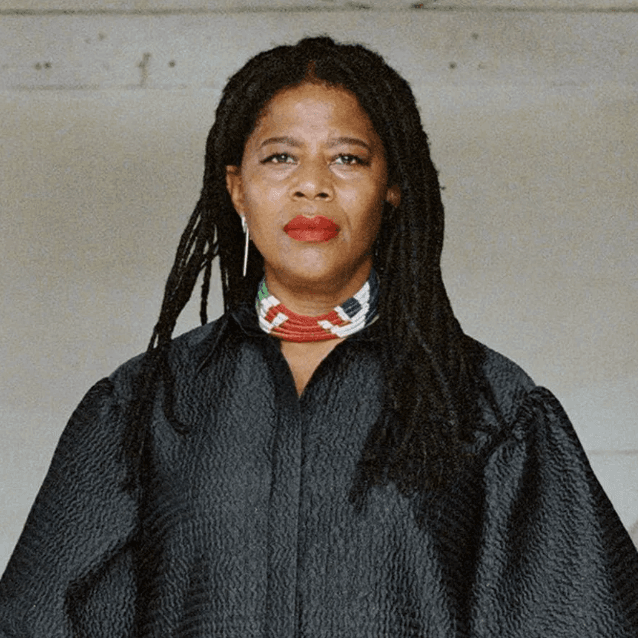
Simone Leigh is an American artist whose work has reshaped contemporary sculpture by insisting on the centrality of Black women’s lives, knowledge systems, and aesthetic traditions. Working across sculpture, installation, and social practice, Leigh has developed a visual language that is at once formal, political, and deeply embodied. Her practice resists spectacle and narration in favor of presence: bodies that are solid, autonomous, and self-possessed, often monumental in scale and resolutely opaque in meaning.
Leigh was born in Chicago in 1967 and raised in the city’s South Side, an environment that shaped her early understanding of race, community, and structural inequality. She initially studied philosophy at Earlham College, a background that continues to inform her approach to form and meaning. Rather than treating art as illustration, Leigh approaches it as a mode of inquiry—one that asks how knowledge is produced, who is allowed visibility, and what histories are preserved or erased. Her eventual turn toward ceramics was not a rejection of theory but an extension of it, allowing her to think through material, labor, and the body simultaneously.
Clay has remained a foundational material in Leigh’s practice, both for its physical properties and its historical associations. Ceramics, long relegated to the category of craft and frequently feminized or devalued within Western art hierarchies, becomes in her hands a site of intellectual rigor and cultural memory. Leigh’s early ceramic works often took the form of vessels, masks, and hybrid figures that referenced African sculptural traditions without directly reproducing them. These forms were not meant to be ethnographic citations, but rather meditations on how diasporic memory persists through abstraction, gesture, and repetition.
Over time, Leigh’s figures grew in scale and complexity. Her sculptures frequently depict female bodies without faces, or with features that merge seamlessly into architectural or botanical forms. This withholding of facial expression is deliberate. Her figures do not perform identity; they occupy space. The absence of eyes or mouths does not signal erasure, but autonomy—an insistence that interiority does not require access.
Architecture plays a crucial role in Leigh’s work, particularly vernacular structures from across the African continent and its diaspora. Thatched roofs, domes, and compound-like forms appear repeatedly, often fused with the female body. These hybrid structures collapse distinctions between shelter and self, suggesting bodies as sites of protection, continuity, and collective memory. Rather than treating architecture as neutral infrastructure, Leigh frames it as a cultural expression shaped by climate, ritual, and social relations—knowledge systems often excluded from Western modernism’s canon.
Leigh’s engagement with Black feminist thought is foundational, though rarely didactic. Her work is informed by thinkers such as Audre Lorde, bell hooks, and Saidiya Hartman, particularly their writings on care, labor, and the politics of refusal. Yet Leigh does not translate theory into text or symbolism. Instead, she allows these ideas to shape the conditions under which her work exists: its slowness, its weight, its resistance to easy consumption. The sculptures demand time, both in their making and in their viewing, mirroring the often-invisible labor they honor.
In addition to her studio practice, Leigh has been deeply invested in collective and social projects. One of the most significant was The Waiting Room (2016), a multi-part installation and program that addressed Black women’s health and wellness. Developed in collaboration with researchers, healers, and community organizers, the project functioned as both artwork and intervention. It foregrounded practices of care—herbal medicine, breathwork, rest—as forms of knowledge historically marginalized or dismissed. For Leigh, this work was not a departure from sculpture, but an expansion of it, treating social space itself as a material.
Leigh’s move into large-scale bronze sculpture marked a shift in both medium and reception, though not in intent. Bronze, a material traditionally associated with monuments and state power, allowed her to claim physical and symbolic space long denied to Black women. Works such as Brick House exemplify this turn: a towering female form whose skirt becomes a house-like structure, rooted and immovable. The sculpture does not commemorate an individual or event; it asserts existence itself as monumental.
International recognition followed, but Leigh has remained attentive to the conditions under which visibility is granted. Her selection to represent the United States at the Venice Biennale in 2022 marked a historic moment, yet her presentation avoided nationalistic triumph. Instead, she filled the U.S. Pavilion with works that foregrounded diasporic histories and non-Western forms, subtly undermining the pavilion’s symbolic authority. Her concurrent exhibition at the Arsenale further expanded these themes, situating Black female subjectivity within a global, rather than national, frame.
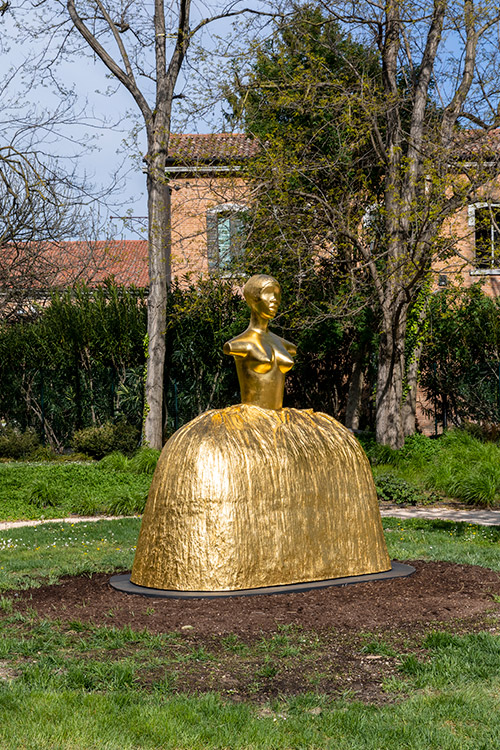
Image Source: LINK
Leigh’s work is notable for its restraint. In an art world often driven by novelty and self-disclosure, her practice is grounded, deliberate, and uncompromising. She does not explain her figures or resolve their contradictions. This refusal is not aloofness, but care, an insistence that some forms of knowledge are not extractive, and that some histories cannot be summarized without distortion.
Today, Simone Leigh is widely regarded as one of the most significant artists of her generation. Through form, material, and scale, Leigh has built a practice that honors endurance, opacity, and quiet authority—qualities too often denied to the subjects she centers, and precisely the ones her work makes impossible to ignore.